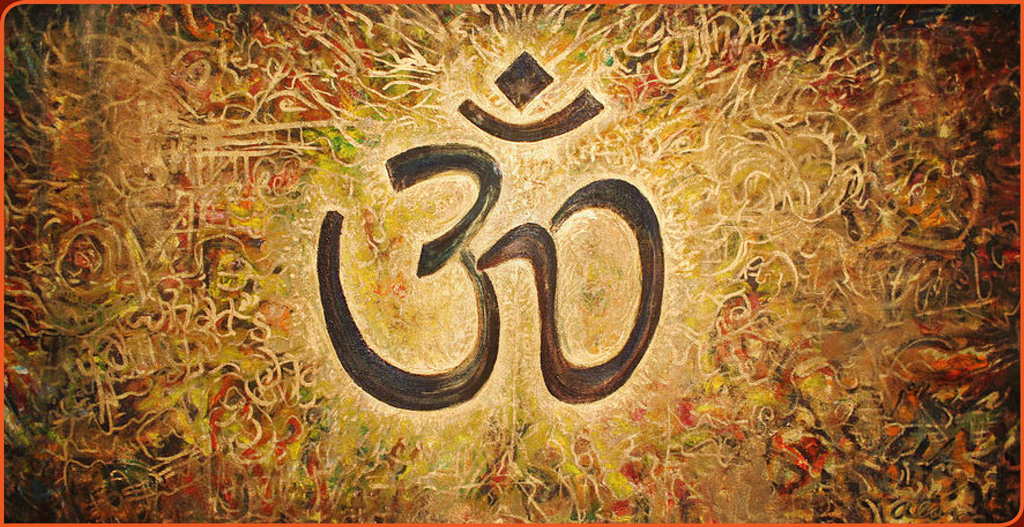


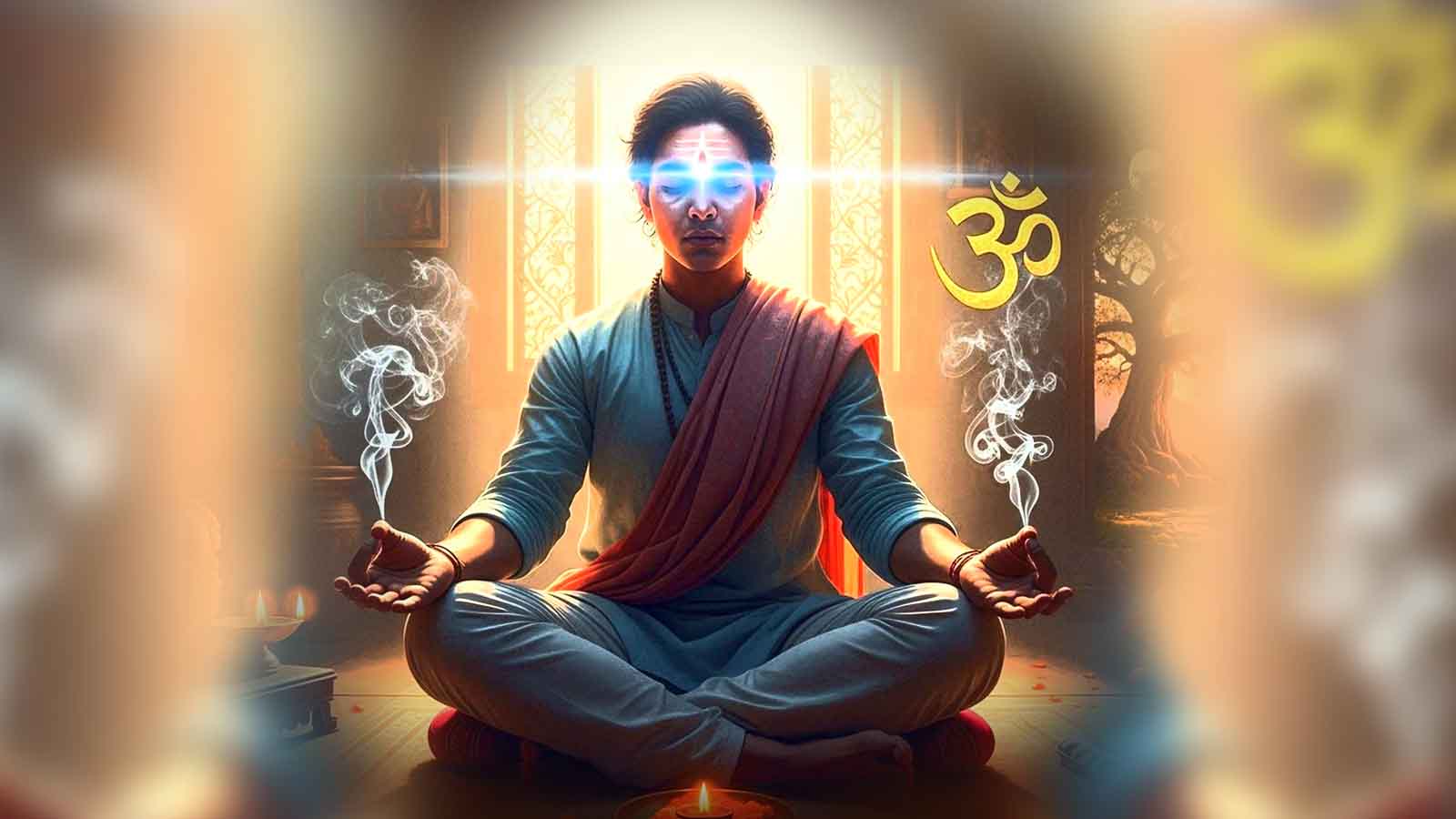
What is ॐकार, oṃkāra? And why should one worship ॐकार, oṃkāra? Upaniṣad (उपनिषद्) has given Upāsanāḥ (उपासनाः) of which the primary Upāsanā (उपासना) is of ॐकार, oṃkāra, generally chanted in association with a given Mantra (मन्त्र). ॐ श्री राम जय राम जय जय राम, oṃ śrī rāma jaya rāma jaya jaya rāma, or ॐ नमः शिवाय, oṃ namaḥ śivāya, or ॐ श्री कृष्ण शरणं मम, oṃ śrī kṛṣṇa śaraṇaṃ mama. Every Mantra (मन्त्र) begins with ॐ, oṃ. We Indians have grown up in a culture where ॐ, oṃ, is present whenever you meet a Svāmī (स्वामी) or go to an Āśrama (आश्रम). ॐकार, oṃkāra, is always going on when you do Mantrajapa (मन्त्रजप). Some people even do Japa (जप) or do Mālā (माला), chanting ॐ, oṃ, ॐ, oṃ, ॐ, oṃ. It is common, but then people rarely know what it is. ॐ, oṃ, the ॐकार, oṃkāra can be looked at in a threefold way. It is derived from the root अव्, av, to protect, रक्षणे, rakṣaṇe, for protection. Av (अव्) also means blessings. ॐकार, oṃkāra, means that which protects, that which blesses; so grammatically, ॐकार, oṃkāra, means Īśvara (ईश्वर). You can transcend the word and think of Īśvara (ईश्वर), the protector who blesses you. There is another way to look at ॐकार, oṃkāra. It can be looked at as कर्तृ, kartṛ, in the sense of कर्ता, kartā, doer. ॐकार, oṃkāra, means one who creates, one who protects, and one who blesses, and that is Īśvara (ईश्वर).
Phonetically, it also implies Īśvara (ईश्वर). How? Look at the words Nāma (नाम) and Nāmī (नामी). Nāma (नाम) means a word. Nāmī (नामी) means that which is revealed by the word. In other words, the word and the object are inseparable. It is just a sound when you utter a word, Nāma (नाम), or say something. But the corresponding object will certainly come to your mind. You cannot remain without that object. When someone says “Car,” an object car will come to your mind. You are listening phonetically, but the object car is revealed in your mind. Is it possible that when someone says, “Car,” nothing comes to your mind? It never happens unless there is some meaningless sound. If someone says “USA,” the whole country comes to mind. If someone says “India,” the whole country comes to mind. Or, if someone says “Mother,” the person, the mother, comes to mind. The name and the corresponding object are “as though” inseparable. Mahākavi Kālidāsa (महाकवि कालिदास) in his Raghuvaṃśa (रघुवंश) in Maṅgalācaraṇa (मङ्गलाचरण) says, “वागर्थाविव संपृक्तौ वागर्थप्रतिपत्तये, जगतः पितरौ वन्दे पार्वतीपरमेश्वरौ, vāgarthāviva saṃpṛktau vāgarthapratipattaye, jagataḥ pitarau vande pārvatīparameśvarau. I do Namaskāra (नमस्कार) to the parents of this world, Pārvatī (पार्वती) and Parameśvara Śiva (परमेश्वर शिव). How are they? Śiva (शिव) and Pārvatī (पार्वती) are united; they are one, the Ardhanārīśvara (अर्धनारीश्वर). How are they united? How are they non-separate? Like Vāgarthāviva (वागर्थाविव); like Vāk (वाक्) and Artha (अर्थ), meaning like word and its meaning. Anything someone says, the corresponding object comes to mind; it is inseparable from the statement. So also Śiva (शिव) and Pārvatī (पार्वती), who are the parents of the Jagat (जगत्), are inseparable, and I offer my salutations. For what? Vāgarthapratipattaye (वागर्थप्रतिपत्तये), to know the Śāstra (शास्त्र) for Jñāna (ज्ञान).
Īśvara (ईश्वर) is all-pervasive. Īśvara (ईश्वर) is the cause (Kāraṇam, कारणम्) for creation (Utpatti, उत्पत्ति), sustentation (Sthiti, स्थिति), and dissolution (Laya, लय). The word that implies all-pervasiveness and the ability to create, sustain, and dissolve is ॐ, oṃ. It is a sound symbol. How? The sound ॐ, oṃ, consists of three letters: अ (a), उ (u), and म् (m). The अ (a) is the most natural; the expression is effortless, and the most naturally expressed sound. There may not be a corresponding alphabet in a given language, but still, anyone can open their mouth and create the sound of अ (a). There is a reason why English pronunciation differs from that of Indians. In the Devanāgarī (देवनागरी) script, we have thirteen vowels,अ, आ, इ, ई, उ, ऊ, ए, ऐ, ओ, औ, ऋ, ॠ, and ऌ. The vowels are either Hrasva (ह्रस्व, short) or Dirgha (दिर्घ, long), usually referring to the duration of the vowel sounds in a word. Vowels like अ, इ, उ, ए, ओ, ऋ, ऌ are known as and pronounced as Hrasva (ह्रस्व) or simply shorter. Vowels like आ, ई, ऊ, ऐ, औ, ॠ are known as and pronounced as Dirgha (दिर्घ) or longer. English has only five vowels: a, e, i, o, and u. So when there is “a” in a word, Westerners are used to pronouncing the word with the sound of “a.” They cannot know whether it is अ (a), आ (ā), or ए (e). The last letter of the ॐकार, oṃkāra, is म् (m); it is pronounced with a closed mouth. The importance of letters अ (a), अकार, akāra, and म् (m), मकार, makāra, is seen in the fact that when a baby first learns to speak, it first utters म (ma), मा (mā), अम्मा (ammā). It is natural. Both अ (a) and म् (m) are natural. All the other vowels are nothing but variations of अकार, akāra, including उकार, ukāra. So when you pronounce ॐ, oṃ, between अ (a) and म् (m), the अकार, akāra, reflects or symbolizes all the vowels, and the मकार, makāra, symbolizes all the consonants. Since the combination of vowels and consonants forms words, the word ॐ, oṃ, includes all the words. Reiterating, the single-syllable word ॐ, oṃ, includes all the words. All the nouns are included in the word ॐ, oṃ. Nāma (नाम) and Nāmī (नामी) are non-separate; the noun and its corresponding word are non-separate, so the ॐकार, oṃkāra, indicates the Viśvarūpa (विश्वरूप), the all-pervasiveness of Īśvara (ईश्वर). ॐकार, oṃkāra, is a sound syllable indicating Īśvara (ईश्वर).
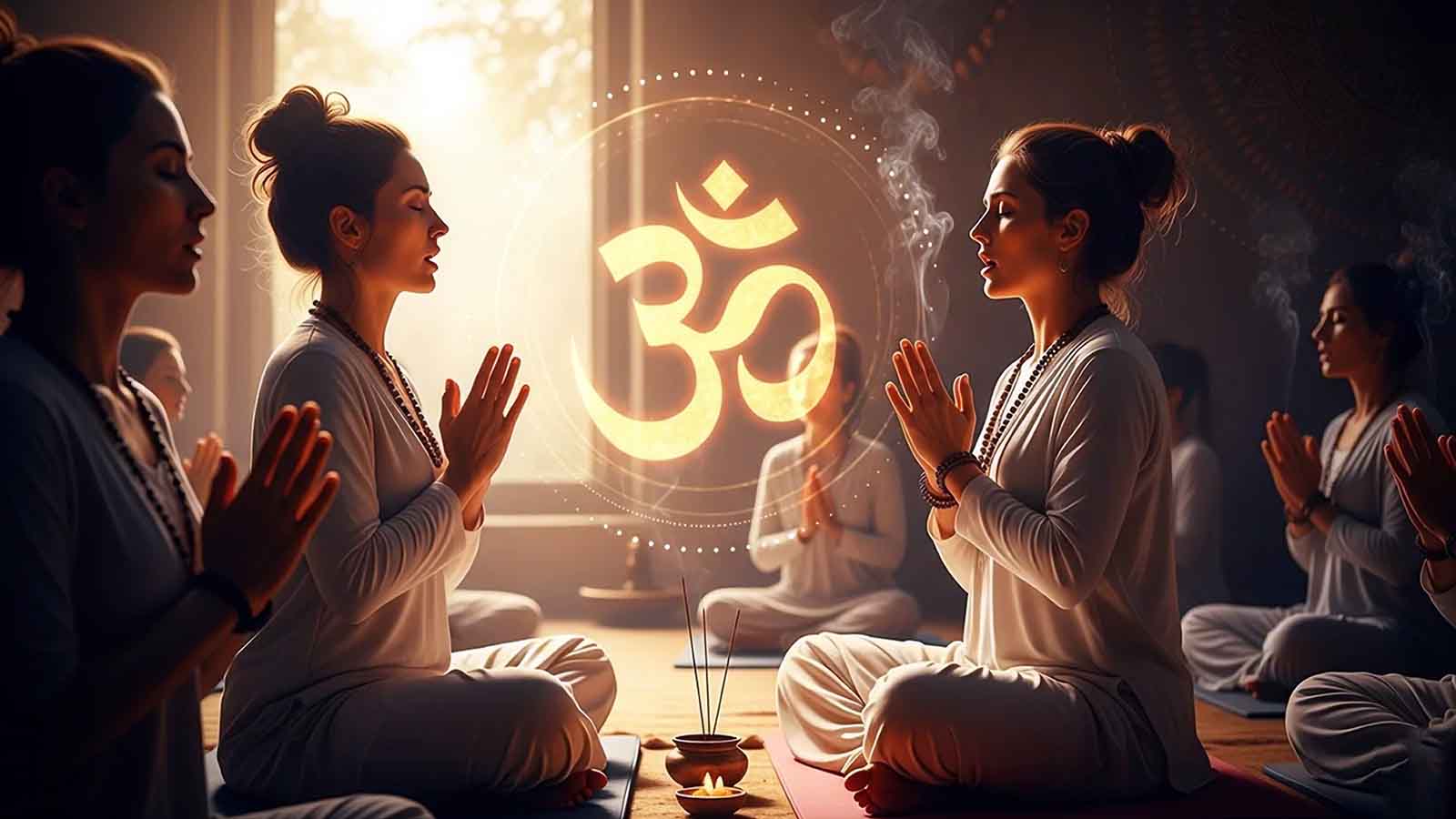
And Śāstra (शास्त्र) also does this Adhyāropa (अध्यारोप) that includes the transcendental nature of Īśvara (ईश्वर). It expresses the three Mātrāḥ (मात्राः), अ (a), उ (u), and म् (m) as the three Avasthāḥ (अवस्थाः), the three Mātrāḥ (मात्राः) as the three Śarīrāṇi (शरीराणि), and the three Mātrāḥ (मात्राः) as the three expressions of Īśvara (ईश्वर): Īśvara (ईश्वर), Hiraṇyagarbha (हिरण्यगर्भ), and Virāṭ (विराट्). So, when we say that everything has come from ॐकार, oṃkāra, it implies that ॐकार, oṃkāra, is a symbol of Īśvara (ईश्वर), both phonetically and grammatically, and from the standpoint of Śāstra (शास्त्र) as well. There are certain Adhyāropāḥ (अध्यारोपाः), even by Śāstra (शास्त्र), that are there in our psyche; it is natural, like on Dhanatrayodaśī (धनत्रयोदशी), we do Lakṣmīpūjana (लक्ष्मीपूजन). Any coin, gold, silver, or any metal is a symbol of Lakṣmī (लक्ष्मी). That is Adhyāropa (अध्यारोप). Or on Daśaharā (दशहरा), we do Śastrapūjā (शस्त्रपूजा), a simple weapon is enough to do Śastrapūjā (शस्त्रपूजा. Nowadays, weapons such as drones and missiles are controlled digitally, but still, we do sword Pūjā (पूजा). Śāstra (शास्त्र) does a deliberate loading of the three Avasthāḥ (अवस्थाः) on ॐकार, oṃkāra. There is a deliberate loading of three Śarīrāṇi (शरीराणि) on ॐकार, oṃkāra, just as we have certain forms on which we load Īśvara (ईश्वर). When you say ॐ, oṃ, it is सर्वरूप परमात्मा, sarvarūpa paramātmā, the Īśvara (ईश्वर) in all forms.
When Arjuna (अर्जुन) asks Bhagavāna Śrī Kṛṣṇa (भगवान श्री कृष्ण) what are your glories, Bhagavāna (भगवान) says, “नान्तोऽस्ति मम दिव्यानां विभूतीनां परन्तप, nānto’sti mama divyānāṃ vibhūtīnāṃ parantapa.” Hey, Arjuna (अर्जुन)! My divine glories are endless. In the 11th Chapter, Viśvarūpa Darśana (विश्वरूप दर्शन), Bhagavāna (भगवान) reveals the all-inclusive form. That all-inclusive word is ॐ, oṃ. When you say ॐ, oṃ, it means विश्वरूप ईश्वर, viśvarūpa īśvara. When you say ॐ, oṃ, that is हिरण्यगर्भरूप ईश्वर, hiraṇyagarbharūpa īśvara, whatever form you want to see.
Whenever we chant a Mantra (मन्त्र) like “ॐ नमः शिवाय, oṃ namaḥ śivāya,” you start with ॐ, oṃ. When you say, “नमः शिवाय, namaḥ śivāya,” it signifies my salutation or my Praṇāma (प्रणाम) to Mahādeva Śiva (महादेव शिव). Mahādeva Śiva (महादेव शिव) is a particular form, when you say Śiva (शिव), “त्रिनेत्र त्रिशूलधारी जटाजूटधारी, trinetra triśūladhārī jaṭājūṭadhārī,” that particular form will come in the mind. But that is a limited form, with two hands, two feet, meditating in Kailāsa (कैलास), space-wise limited, action-wise limited, and so many other limitations. However, to indicate that the limitless appears as limited, the mind needs the support of a form to understand, hold on, and connect to that limitless. That is because the mind has limitations, as it cannot function without forms. Therefore, Śiva (शिव) is there, but what is Śiva (शिव)? ॐ, oṃ. It means limitless, all-pervasive, unconditioned, any which way, time-wise, space-wise, and objectivity-wise; in no way is it limited, देश काल वस्तु परिच्छेद शुन्य, deśa kāla vastu pariccheda śunya. The limitlessness of Īśvara (ईश्वर) is revealed by ॐ, oṃ. Anything limitless, anything that is free from any conditioning, has to be formless. If it has form, then it is limited. So ॐकार, oṃkāra, reveals formless Īśvara (ईश्वर). And, ॐकार, oṃkāra, reveals Jagadkāraṇam (जगद्कारणम्), Utpattisthitilayakāraṇam (उत्पत्तिस्थितिलयकारणम्), that is Īśvara (ईश्वर). ॐकार, oṃkāra, reveals both. Since it reveals the limitlessness of Īśvara (ईश्वर), you always start with ॐ, oṃ. You will find ॐ, oṃ, associated with every Mantra (मन्त्र) and chanted initially, like the शान्ति मन्त्राः, śānti mantrāḥ, such as ॐ सह नाववतु,। सह नौ भुनक्तु, oṃ saha nāvavatu, saha nau bhunaktu or ॐ भद्रं कर्णेभिः श्रृणुयाम देवाः, oṃ bhadraṃ karṇebhiḥ śrṛṇuyāma devāḥ. So the ॐकार, oṃkāra, reveals what? “इदं सर्वं ब्रह्मन्, idaṃ sarvaṃ brahman.” Brahman (ब्रह्मन्) that is ॐकार, oṃkāra. And, Śruti (श्रुति) does Adhyāropa (अध्यारोप) in the Māṇḍukyopaniṣad (माण्डुक्योपनिषद्) such as “अयम् आत्मा ब्रह्म, ayam ātmā brahma,” or “अयम् आत्मा चतुष्पात्, ayam ātmā catuṣpāt.”
To gain knowledge of anything, you require a mind that is ready for knowledge and mental preparedness. Mental preparedness is in terms of Śuddhi (शुद्धि) and Ekāgratā (एकाग्रता), purity and single-pointedness of the mind. It is gained through Upāsanāḥ (उपासनाः), Japa (जप) of various Mantrāḥ (मन्त्राः), Pūjā (पूजा), Yātrā (यात्रा), Tapas (तपस्), Ityādi (इत्यादि). Śāstra (शास्त्र) has given us this: one can do Upāsanā (उपासना) with ॐकार, oṃkāra. But how should that be? It should be such that in ॐकार, oṃkāra, there is Īśvarabuddhi (ईश्वरबुद्धि). When you chant ॐ, oṃ, there is awareness of Īśvara (ईश्वर). When you chant “ॐ श्री कृष्ण शरणं मम, oṃ śrī kṛṣṇa śaraṇaṃ mama,” Bhagavāna Śrī Kṛṣṇa (भगवान श्री कृष्ण) is in the mind. When you chant “ॐ नमः शिवाय, oṃ namaḥ śivāya,” Mahādeva Śiva (महादेव शिव) is in the mind. When you chant simple ॐ, oṃ, that is formless Īśvara (ईश्वर), limitless Īśvara (ईश्वर), उत्पत्तिस्थितिलयकर्ता ईश्वर, utpattisthitilayakartā īśvara, that Īśvara (ईश्वर) who is the being of everything, one must have that Buddhi (बुद्धि), that understanding. If one chants ॐकार, oṃkāra with that Bhāva (भाव) then it gives अन्तः शुद्धि, antaḥ śuddhi. Any Mantrajapa (मन्त्रजप), or even any Pūjā (पूजा), Bhakti (भक्ति), or Yātrā (यात्रा), can give you अन्तः शुद्धि, antaḥ śuddhi, if it is done with Īśvarabhāva (ईश्वरभाव). You may do Japa (जप), but your mind is on your job, on the stock market loss you incurred, or any other problem in your life; your tongue is uttering the words, but your Bhāva (भाव) is in your job, the stock market, or some pain. That doesn’t give Śuddhi (शुद्धि). Śuddhi (शुद्धि) can come only when the Japa (जप) is done with Īśvarabhāva (ईश्वरभाव). Similarly, ॐकार, oṃkāra-chanting done with Īśvarabhāva (ईश्वरभाव) will give अन्तः शुद्धि, antaḥ śuddhi, purity of the mind. And, if you look at ॐकार, oṃkāra, as formless Brahman (ब्रह्मन्), अमात्र ॐकार, amātra oṃkāra, it leads to knowledge. So it is a Pratika (प्रतिक) for सगुण उपासना, saguṇa upāsanā, and a Pratika (प्रतिक) to understand Īśvara (ईश्वर) also.
You have to remember that Brahman (ब्रह्मन्) is the Lakṣya (लक्ष्य) of ॐकार, oṃkāra. Simple sound doesn’t enlighten you. Śruti (श्रुति) says, ॐ इति एवं ध्यायथ, oṃ iti evaṃ dhyāyatha. By Dhyāna (ध्यान), let this be, what? तमसः परस्तात्, tamasaḥ parastāt. Cross over ignorance. Simple chanting of ॐकार, oṃkāra, doesn’t let you cross ignorance. They say to meditate on Nādabrahma (नादब्रह्म), because after Māyā (माया), the first thing born is Ākāśaḥ (आकाशः), तस्माद्वा एतस्मादात्मन आकाशः सम्भूतः, tasmādvā etasmādātmana ākāśaḥ sambhūtaḥ. The Guṇa (गुण) of Ākāśaḥ (आकाशः) is sound. Śabda (शब्द) is Guṇa (गुण) of Ākāśaḥ (आकाशः). The first thing is Nāda (नाद), and therefore, Nādabrahma (नादब्रह्म). ओंकारश्चाथ शब्दश्च द्वाविमौ ब्रह्मणः पुरा, कण्ठं भित्वा विनिर्यातौ तस्मान्माङ्गलिकावुभौ, oṃkāraścātha śabdaśca dvāvimau brahmaṇaḥ purā, kaṇṭhaṃ bhitvā viniryātau tasmānmāṅgalikāvubhau. When Brahmājī (ब्रह्माजी) was born, the first thing he said was ॐ, oṃ. So ॐ, oṃ, sound is auspicious. That is why you begin your activities with the utterance of ॐ, oṃ. Even in Gītājī (गीताजी), it is said, “ॐ तत्सदिति निर्देशः, oṃ tatsaditi nirdeśaḥ.”There is a Nirdeśa (निर्देश), it is implied. How is it implied? For that, you have to study from a teacher and then meditate. ॐ इति, oṃ iti, that Iti (इति) is important. Look at ॐ, oṃ, as Brahman (ब्रह्मन्). You have to look at ॐ, oṃ, as Ātmā (आत्मा). Which Ātmā (आत्मा)? All-pervasive Ātmā (आत्मा), everything is woven in whom. You have to look at Śālīgrāma (शालीग्राम) as Viṣṇu (विष्णु) and Viṣṇu (विष्णु) as Īśvara (ईश्वर), or Śivaliṅga (शिवलिङ्ग) as Īśvara (ईश्वर). This is deliberate Adhyāsa (अध्यास). You have to look at the form and appreciate what it is. You have to study. Simply saying, “अहं ब्रह्मास्मि, ahaṁ brahmāsmi,” the person becomes more emotional to Brahman (ब्रह्मन्). The person becomes more subjective. You have to be objective. First, you understand Brahman (ब्रह्मन्). That is Vairāgya (वैराग्य). So Śravaṇa (श्रवण), Manana (मनन), and Nididhyāsana (निदिध्यासन) is necessary. Then, you do meditation.
You meditate upon ॐकार, oṃkāra, to understand the self. You should look up to ॐकार, oṃkāra, as the manifestation of self. How do you say so? That is to be learned. That is why you have to study Śāstra (शास्त्र). How ॐकार, oṃkāra, is the Lakṣyārtha (लक्ष्यार्थ) of self? When you meditate upon ॐकार, oṃkāra, you create Bhagavadbuddhi (भगवद्बुद्धि), “as though.” When a symbol or an idol is given, particularly if you are born in India, from childhood, there is Bhagavadbuddhi (भगवद्बुद्धि) in Rāma (राम), Kṛṣṇa (कृष्ण), Viṣṇu (विष्णु), Śiva (शिव), or Hanumāna (हनुमान). If the person has not traveled and doesn’t know, he may not know it. But we impute Bhagavadbuddhi (भगवद्बुद्धि); we look upon Rāma (राम) as Bhagavāna (भगवान). We look upon Kṛṣṇa (कृष्ण) as Bhagavāna (भगवान). We look upon Viṣṇu (विष्णु), Śiva (शिव), or Hanumāna (हनुमान) as Bhagavāna (भगवान). That is called deliberate Adhyāsa (अध्यास). That form that is created is not God. We create the form of a given God because the mind needs to connect God to a given form. Unless there is a form, the mind cannot connect to Īśvara (ईश्वर). That is why different forms are provided for Īśvara (ईश्वर). That is the beauty of our culture. We start looking at the forms as Īśvara (ईश्वर) only. Similarly, you look at ॐकार, oṃkāra, “as though” Brahman (ब्रह्मन्), that is the self, not separate from the self. For that, one needs to understand the symbol ॐकार, oṃkāra, and its Lakṣyam (लक्ष्यम्). It is not independent; it is a Lakṣyam (लक्ष्यम्) that you must discover. You have to learn the Lakṣyārtha (लक्ष्यार्थ) of ॐकार, oṃkāra,. You have to understand what is ॐकार, oṃkāra, त्रिमात्र ॐकार, trimātra oṃkāra, and अमात्र ॐकार, amātra oṃkāra. अमात्र ॐकार, amātra oṃkāra, reveals the self-consciousness. Figuratively, for our understanding of Upāsanā (उपासना), the Sthūlaśarīra (स्थूलशरीर) is Sthānam (स्थानम्) for the Ātmā (आत्मा), the physical heart is understood as the Sthānam (स्थानम्) of the Ātmā (आत्मा), and you meditate on the Ātmā (आत्मा) with the help of ॐकार, oṃkāra. The Prakṛtātmā (प्रकृतात्मा), the obtaing Ātmā (आत्मा) is Jīva (जीव). Simply chanting ॐकार, oṃkāra, on the Ātmā (आत्मा) doesn’t help. You have to understand which Ātmā (आत्मा)? यस्मिन् द्यौः पृथिवी चान्तरिक्षमोतं मनः सह प्राणैश्च सर्वैः, yasmin dyauḥ pṛthivī cāntarikṣamotaṃ manaḥ saha prāṇaiśca sarvaiḥ. The one in which everything is woven “as though.” तद् सत्यं तद् अमृतं, tad satyaṃ tad amṛtaṃ,” that which is Satyaṃ (सत्यं), that which is Amṛtaṃ (अमृतं). That Ātmā (आत्मा) is Antaḥkaraṇam (अन्तःकरणम्). तम् ध्यायथ ॐ, tam dhyāyatha oṃ. By simply chanting ॐ, oṃ, ॐ, oṃ, ॐ, oṃ, nothing will happen. It is just a sound. It may help you quiet your mind for a moment, but not always. To meditate on ॐकार, oṃkāra, you need to study from a teacher. That ॐकार, oṃkāra, is a symbol. ॐ इति एक अक्षरं ब्रह्म, oṃ iti eka akṣaraṃ brahma, it is for Upāsanā (उपासना). It is a symbol of Saguṇabrahman (सगुणब्रह्मन्) as well as the Nirguṇabrahman (निर्गुणब्रह्मन्). अमात्र ॐकार, amātra oṃkāra, is the symbol of Nirguṇabrahman (निर्गुणब्रह्मन्). One needs to understand the Lakṣyārtha (लक्ष्यार्थ). That means Ātmā (आत्मा) is Īśvara (ईश्वर). You meditate, understanding that Ātmā (आत्मा) is Nirguṇabrahman (निर्गुणब्रह्मन्). Then it makes some sense, simply chanting ॐ, oṃ, ॐ, oṃ, ॐ, oṃ, doesn’t give any Phala (फल), except some concentration and some purity.

![[ India Today ] Ohio senator JD Vance thanks wife, a Hindu, for helping him find Christian faith](https://hinduvishwa.org/wp-content/uploads/2024/06/us-senator-jd-vance-reveals-how-his-hindu-wife-usha-helped-him-find-his-christian-faith-image-re-272530504-16x9_0-120x86.webp)