
Across India, traditional rituals are giving way to vacations, hashtags, and corporate promotions. This essay investigates how the blending of secular modernity and global consumerism is transforming Hindu festivals from sacred observances into hollow displays of lifestyle and leisure.
By Rati Agnihotri
- The woke and secular portrayal of Hindu festivals has reduced them to shallow versions of the deep values, traditions, and way of life they truly represent.
- Excessive commercialization now works hand in hand with wokeism, eroding Hindu traditions and weakening the cultural fabric.
- A growing number of urban Indians are choosing vacations during the “festive season” instead of celebrating festivals in the traditional way with their families.
- The Hindu community must act to limit the damage and ensure that commercialization does not strip festivals of their true cultural and spiritual essence.
- As traditional knowledge fades rapidly, documenting rituals and customs has become essential to prevent future generations of Hindus from becoming disconnected from their cultural and civilizational roots.
The past decade has marked the beginning of Bharat’s De-Macaulization—a gradual liberation of the Indian psyche from colonial conditioning. The uncritical reverence once accorded to English and Western epistemic systems is slowly giving way to pride in indigenous knowledge and Vedic wisdom. This civilizational resurgence is visible in the construction of the Ayodhya Ram Mandir, the revival of ancient pilgrimage centers, the growth of Dharmic tourism, and the inclusion of India’s civilizational ethos in its foreign policy and national self-image.
Yet beneath these large-scale shifts, India’s cultural microcosm tells a more complex story. Urban civil society and media spaces remain dominated by left-liberal and woke sensibilities, distancing many Indians from their cultural roots. This duality—civilizational reawakening at the macro level and erosion at the micro—creates a paradoxical national mood.
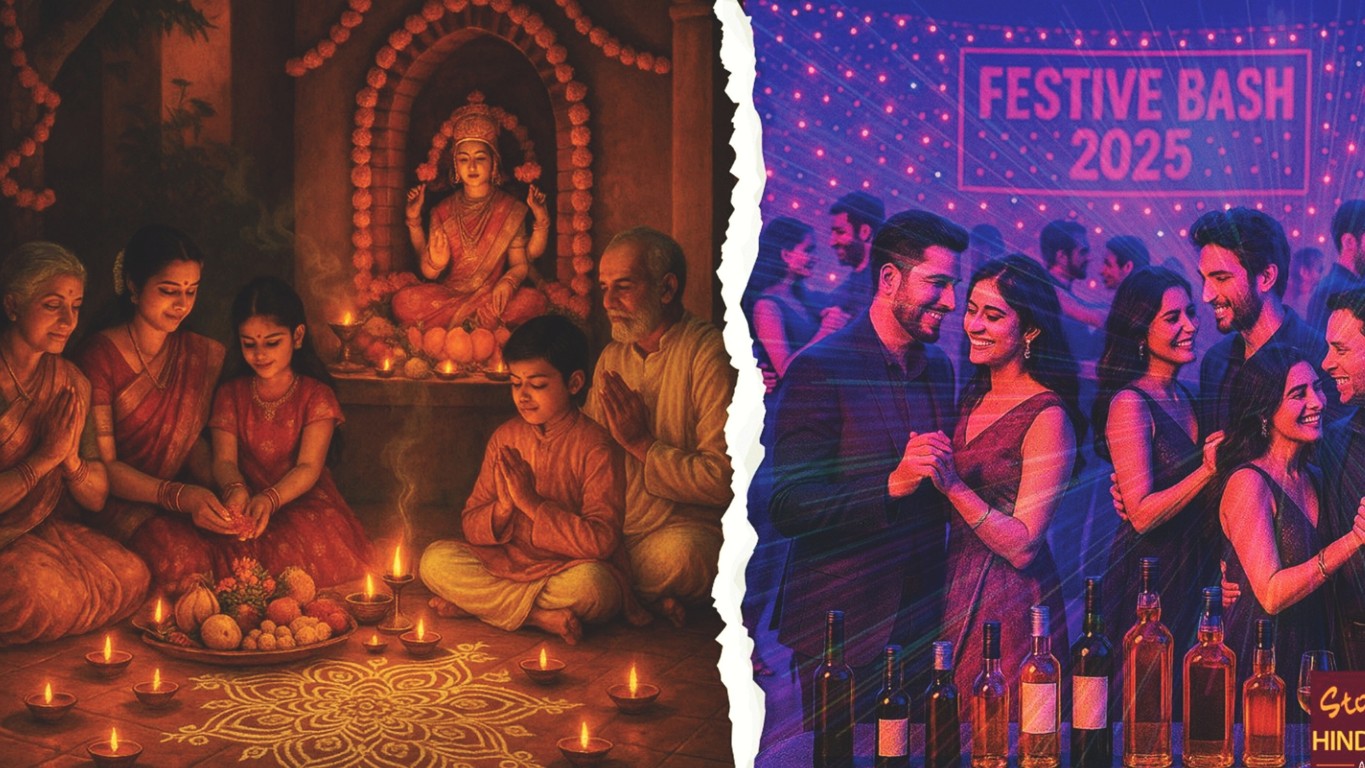
Hindu festivals illustrate this tension vividly. Once expressions of deep philosophical meaning and community bonding, they are increasingly reduced to consumerist spectacles. Commercialization and a shallow pursuit of “fun” have replaced ritual, reflection, and reverence. The same cultural forces that label traditional attire “ethnic” now repackage festivals in secular or trendy forms, stripping them of meaning. What remains is a hollow celebration—vibrant in form but fading in spirit—marking a quiet but steady cultural amnesia among urban Indians.
This article will examine this growing disconnection, exploring how India’s civilizational renaissance coexists with subtle but significant cultural erosion.
Wokeism Meets Crass Commercialization
StopHinduvesha has discussed in its previous stories[1] how wokeism targets Hindu festivals to propagate anti-Hindu narratives and forcefully secularize them. From the whole narrative-building exercise around the burning of firecrackers in Diwali to the covertly Hinduphobic agenda of commercials like the much-talked-about Tanishq ad,[2] Hindu festivals have been slowly turned into a tool of denigrating Hindy traditions.
However, an equally significant but highly overlooked issue is the over-the-top commercialization of Hindu festivals, which works in tandem with wokeism to erode Hindu traditions and culture. In the Indian context, wokeism has intersected with aggressive market dynamics to alienate Indians from their own cultural and Dharmic roots.
From Diwali cocktails[3] [4]to Diwali parties and club nights, the festival is used as a promotional tool to sell all kinds of products and services. Obviously, there is nothing wrong with promoting cocktails or marketing club parties and hangouts. But why drag a Hindu festival into all this? From Holi to Diwali, Hindu festivals are being repackaged as trendy capitalist culture products, endlessly open to distortion and experimentation. That’s why, to those unfamiliar with the traditional aspect of the festival, Holi now evokes images of rave parties and hedonistic revelry, while Diwali evokes images of dressing up in “ethnic glam” and posing alongside diyas and lights. In other words, one becomes a carnival in popular imagination, while the other becomes akin to a cool night party. What’s worse is that even people celebrating these festivals are gradually abandoning traditions and rituals in favor of “fun” and “relaxation”.
From Diwali and Navratri spa offers to the sacred bond of Rakshabandhan being used to sell holiday packages, resort stays, or dinners, Hindu festivals have become convenient marketing props. In the process, the Hindu community is being misled. An upwardly mobile urban middle class in India, groomed in secularism, drifts further from its traditional roots when bombarded with feel-good “secular” images of Diwali shopping, Rakshabandhan dinner, and Navratri dandiya nights at luxury clubs.
The hashtag “diwalicelebration” has about 1.5 million posts on Instagram. Yet, one hardly sees any content on the traditional roots of Diwali and its Hindu origins. The social media feed of Diwali is filled with influencers marketing everything from jewelry, saris, home-décor and bakery products in the name of Diwali.
Similarly, the commercialization of Navratri has hollowed out its essence – Devi Puja, Sattvic lifestyle, inculcation of Sattvic values, etc. From Navratri thalis to Navratri mocktails,[5] the sacred worship of the nine forms of Maa Durga has been trivialized into a marketing trend.
The homogenization of Hindu festivals under the banner of secularism altogether strips them of their Dharmic and cultural essence. When Deepawali celebrations are reduced to lighting of lamps, exchange of designer gift hampers, and posing in “ethnic wear”, the rich regional and familial traditions of the festival are diluted or lost.
For example, the hill state of Uttarakhand has many versions of Diwali – Raj Bagwal in Tehri district, Igas in the areas near Tehri, Mangseer Bagwal Diwali, and Kumaoni Diwali, among others. In each of these versions of Diwali, local folklore of the region enriches the celebrations, which are very specific and unique. For example, in Kumaoni Diwali, sugarcanes are known to be hung from the balcony of the house so that “the Gods can use them as stairs to enter the house”. Also, pots used for worshipping Mahalaxmi are painted with traditional Aipan art designs of Kumaon, Uttarakhand.[6]
Then, there is the unique Dev Deepawali of Varanasi, celebrated 15 days after the main Diwali celebration. During this festival, homes and temples are illuminated with thousands of earthen lamps, and processions of deities move through the streets amid fireworks and devotional singing. Every temple has its own distinct rituals, which add to the Dharmic significance of the celebrations.[7]
Hindu festivals embody a rich repository of cultural practices, rituals, and traditions passed orally from one generation to the next. The beauty of Hindu Dharma lies in its dynamism – its ability to evolve while retaining its essence. Apart from the regional differences, each family has its own distinct rituals passed down through generations. For example, the Holika Dahan practice varies slightly from family to family, even within the same region. Similarly, the Lashmi-Ganesh Puja rituals of Diwali differ across households, reflecting the flexibility and continuity of the Hindu way of life.
However, as the urban middle class increasingly replaces traditional celebrations with modern and secular versions, a gradual loss of cultural memory is taking place. Fewer people recall why certain rituals exist or what they symbolize. The transition from devotion to decoration and from meaning to marketing reflects not just changing lifestyles but the fading of collective knowledge.
When Family Festivals Turn into Foreign Vacations
The unique essence and Dharmic context of Hindu festivals are rapidly being erased under the homogenized idea of “festive season”.
Under the flashy banner of the festive season, festivals like Navaratri, Durga Puja, Dussehra, and Diwali are slowly losing their cultural relevance and becoming indistinguishable from the global Christmas-New Year marketplace. The trend reflects a systematic effort at the subtle secularization of Hindu festivals, and urban Hindus are embracing it unquestioningly.
Most alarming is the growing tendency among urban Indians to treat the “festive season” as vacation time rather than a period of traditional celebration at home. A recent Times of India report says that Indian travelers are increasingly opting for solo trips this festive season, with millennials leading the shift. The most popular destinations included the UAE, Vietnam, Thailand, Sri Lanka, Indonesia, Malaysia, and Germany. Nearly two-thirds of visas issued for Germany were linked to Oktoberfest travel. The report added that family reunions are being replaced by solo trips, marking a clear change in how festivals are experienced. [8]
“In recent years, the idea of a festive break has taken a dramatic turn due to rising disposable incomes, exposure to global cultures, and the ease of travel. This shift has created opportunities to blend celebration with exploration, turning festivals into memorable vacations”, yet another news report observed. [9]
A 2024 report by The Times of India cites the findings of an American Express survey, which found that 97 percent of Indians planned to travel during the 2024 festive season, with 33 percent having already booked their travels. Leisure was the top motivation for 63 percent of the respondents.[10] The report detailing the long festive weekend calendar is telling of the sorry state of affairs of Hindu traditions and culture in Hindu-majority India. When festivals that once embodied civilizational and cultural consciousness of the society become mere holiday breaks, it signals a society gradually losing its cultural moorings.
For a society already battling culture erosion, it’s deeply troubling when people prefer discounted foreign vacations over celebrating time-honored traditions at home. The language of the “festive season,” crafted to commercially exploit India’s consumer base, effectively strips Hindu festivals of their Hinduness. What was once a spiritual and community experience is now a marketing category.
“Global citizenship,” or being a citizen of the world, is a popular concept today. According to the UN, “Global citizenship is the umbrella term for the social, political, environmental, and economic actions of globally minded individuals and communities on a worldwide scale”. [11] Many argue that the growing desire among Indians to experience other cultures during the festive season reflects this ideal. But true global citizenship cannot flourish at the cost of dismantling indigenous traditions and knowledge systems. In a highly unequal global order characterized by Western hegemony and the dominance of the Abrahamic narrative, global citizenship for Hindus often translates into detachment from their cultural and civilizational roots. When wokeism and modernity intersect with the rhetoric on “global citizenship”, it actively works to amplify the erasure of the belief systems and way of life of already endangered cultures and civilizations. That’s precisely what’s happening with Hindus at the moment.
Guarding Tradition in a Commercial Age
The commercialization of festivals cannot be altogether wished away. However, the Hindu community can take steps to minimize the damage and turn the tide in its favor by ensuring that commercialization doesn’t detract from the essence of Hindu cultural traditions and values. Below are a few ways the Hindu community can turn the tide amidst the growing wave of wokeism and secularism that threatens the civilizational roots of Bharat:
- Revival of the Temple Ecosystem: Renowned author Stephen Knapp has written extensively on promoting Vedic culture in the modern world. He places a lot of emphasis on the revival of the temple ecosystem, arguing that temples should act as classrooms for disseminating Vedic knowledge. Knapp suggests that temples should hold classes for adults to help them better understand the traditions and rituals they observe. [12]
The revival of local temple ecosystems can begin to undo the damage caused by the over-commercialization of Hindu festivals. Community temples should reinvent themselves as vibrant spaces for collective celebration, where festivals are observed with traditional rituals and shared devotion. Such public celebrations would ensure that even those unfamiliar with the practices or unable to perform rituals at home can participate and reconnect with their heritage.
Given that future generations in India may grow up unaware of how to celebrate Hindu festivals traditionally, this revival must begin now. Temples should adopt creative and engaging formats—especially to attract the younger crowd—while staying true to the core of Hindu values and customs. Interactive programs, bhajan evenings, storytelling sessions, and children’s workshops can all serve as ways to keep traditions alive in an appealing, modern context.
- Media Vigilance: The Hindu community must collectively act as an informal ombudsman to ensure Hindu festivals and traditions are portrayed respectfully in popular culture and media representation.
Social media has emerged as a powerful tool in this regard. In recent years, netizens have actively called out Hinduphobic undertones in advertisements and entertainment media. Collective online activism has, in several cases, compelled major brands to withdraw objectionable campaigns. The controversial Tanishq ad is a prime example. In October 2020, the popular jewelry brand Tanishq released an ad around Diwali, which portrayed a Muslim mother-in-law organizing a traditional Hindu baby shower ceremony for their Hindu daughter-in-law. The ad didn’t go well with netizens, who felt it subtly glorified ‘love jihad’. Due to public outrage, the brand had to ultimately take down the ad. [13]
- Innovative Marketing Practices to Revive Tradition: Members of the community must adopt innovative marketing practices to make people appreciate the traditional aspects of Hindu festivals in a fun and engaging way. It could involve hosting Goddess-themed quizzes in cafes, schools, etc., during Navratri; organizing traditional Ramayana performances at cultural centers around Dussehra and Diwali; and conducting traditional Diya-making workshops for kids.
Young social media influencers can play an important role in developing fun and engaging content that teaches people about various rituals and traditions associated with popular Hindu festivals, such as Holi, Diwali, Dussehra, and Rakshabandhan. A write-up published by Pragyata[14] offers a striking example: it described how a wave of Chhath Puja videos on social media captured the ritual’s devotional spirit through soulful songs dedicated to Chhath Maiyya. “In the midst of a plethora of run-of-the-mill online content, the soulful Chhath Puja videos set to Chhathi Maiyya’s melodies are a breath of fresh air,” the writer observed.
- Hindu activism: The Hindu community must also consolidate and collectively pressure the government to establish mechanisms for maintaining the sanctity of Hindu festivals and preventing their appropriation or misuse. Amid growing concerns about Garba-Dandiya events becoming soft targets for “love jihad,” the Vishwa Hindu Parishad (VHP) issued an advisory ahead of the 2025 Navratri celebrations, urging organizers across Maharashtra to restrict non-Hindu participation. The VHP emphasized that despite increasing commercialization, every Garba or Dandiya night begins with an offering to the Goddess and is, by nature, an act of worship. It remains a sacred event, not an entertainment platform for those outside the faith.[15]
Hindu festivals often become vehicles for anti-Hindu propaganda largely due to misplaced notions of secular leniency within the Hindu community. Only through organized Hindu advocacy can the sanctity of these festivals be safeguarded. Collective cultural assertion is essential to ensure that sacred spaces and occasions remain true to their Dharmic intent.
Hindu Billionaires Must Do Their Bit: Hindu billionaires already play a significant role in sponsoring celebrations and events related to Hindu festivals. However, they must exercise discernment to ensure they do not inadvertently support anti-Hindu narratives disguised as ‘inclusive’ or secular initiatives. By monitoring how their funding is utilized and directing it toward projects that deepen public understanding of Hindu traditions, these influential individuals can help preserve the authenticity of Hindu festivals. Supporting educational campaigns, temple-based celebrations, and media content rooted in traditional values can go a long way towards sustaining civilizational continuity.
- Documenting Traditions and Rituals: Traditions and rituals are passed on orally from one generation to the next. These are rarely documented, at least, not in formats that resonate with modern sensibilities. Temple priests and pundits have long been the custodians of ritual knowledge, yet their position in society has been steadily eroded due to decades of ideological hostility and loss of respect for their vocation. As panditaee itself declines, so does the living memory of ritual practice. To prevent this knowledge from disappearing, systematic documentation has become critical. Festivals, prayers, and rituals must be recorded and preserved in accessible forms—through books, films, digital archives, and educational initiatives—to ensure future generations remain connected to their roots.
Closure
Hindu Dharma today stands as one of the few surviving non-Abrahamic faiths. Yet the growing disconnect of Hindus from the Dharmic essence of their festivals threatens this legacy. Unless urgent steps are taken now, the community may soon face cultural amnesia and a loss of continuity with its civilizational past.
Citation
[1] Hindu Identity Under Siege: global Assault on Festivals & Temples; https://stophindudvesha.org/hindu-festivals-and-temples-under-siege-a-systemic-global-assault-on-hindu-identity/
[2] Ad controversy: After internet backlash, Tanishq pulls plug on latest ad – the controversy around ‘Ekatvam’, explained | India News; https://www.timesnownews.com/india/article/after-internet-backlash-tanishq-pulls-plug-on-latest-ad-the-controversy-around-ekatvam-explained/666883
[3] 11 two-minute cocktail recipes for your Diwali party, according to bartenders and experts | GQ India; https://www.gqindia.com/content/10-two-minute-cocktail-recipes-for-your-diwali-party-according-to-bartenders-and-experts
[4] Make Diwali All About These 7 Desi Cocktails | magicpin blog; https://magicpin.in/blog/best-desi-cocktails/?srsltid=AfmBOoovT4QtpBLn-IscgtrbLJf9EPXsu6QECqvZx8gM-TNliPL8R8VD
[5] fizzibomb on Instagram; https://www.instagram.com/p/DPJ2XRpElT1/
[6] Tradition of Bagwal Festival in U’khand | Garhwal Post; https://garhwalpost.in/tradition-of-bagwal-festival-in-ukhand/
[7] Dev Deepawali | Kashmi Official Web portal; https://kashi.gov.in/event/dev-deepawali
[8] More Indians travel solo this festive season, Atlys data shows – The Times of India; https://timesofindia.indiatimes.com/business/india-business/more-indians-travel-solo-this-festive-season-atlys-data-shows/articleshow/124370134.cms
[9] Festive Holiday Travel Trends: How Indians Are Redefining Their Vacation Plans | Travel News – News18; https://www.news18.com/lifestyle/travel/festive-holiday-travel-trends-how-indians-are-redefining-their-vacation-plans-9532265.html
[10] Indians Favor Domestic Travel This Festive Season with Broader Trends Revealed | – The Times of India; https://timesofindia.indiatimes.com/travel/indians-favor-domestic-travel-this-festive-season-with-broader-trends-revealed/articleshow/114727314.cms
[11] Global Citizenship | United Nations; https://www.un.org/en/academic-impact/global-citizenship
[12] Without Promotion, Vedic Culture Cannot be Protected; https://www.stephen-knapp.com/without_promotion_vedic_culture_cannot_be_protected.htm
[13] Tanishq Ad Pulled Amid Trolling; Boycott Call Divides Internet; https://www.ndtv.com/india-news/after-boycotttanishq-trend-shashi-tharoor-asks-why-dont-they-boycott-india-2309248
[14] Bharat’s Festivals: A Celebration of Timeless Devotion; https://pragyata.com/bharats-festivals-a-celebration-of-timeless-devotion/
[15] Don’t allow non-Hindus at garba-dandiya during Navratri festivals in Maharashtra: VHP | Mumbai News – The Indian Express; https://indianexpress.com/article/cities/mumbai/dont-allow-non-hindus-at-garba-dandiya-navratri-festivals-maharashtra-vhp-10261252/

![[ India Today ] Ohio senator JD Vance thanks wife, a Hindu, for helping him find Christian faith](https://hinduvishwa.org/wp-content/uploads/2024/06/us-senator-jd-vance-reveals-how-his-hindu-wife-usha-helped-him-find-his-christian-faith-image-re-272530504-16x9_0-120x86.webp)