

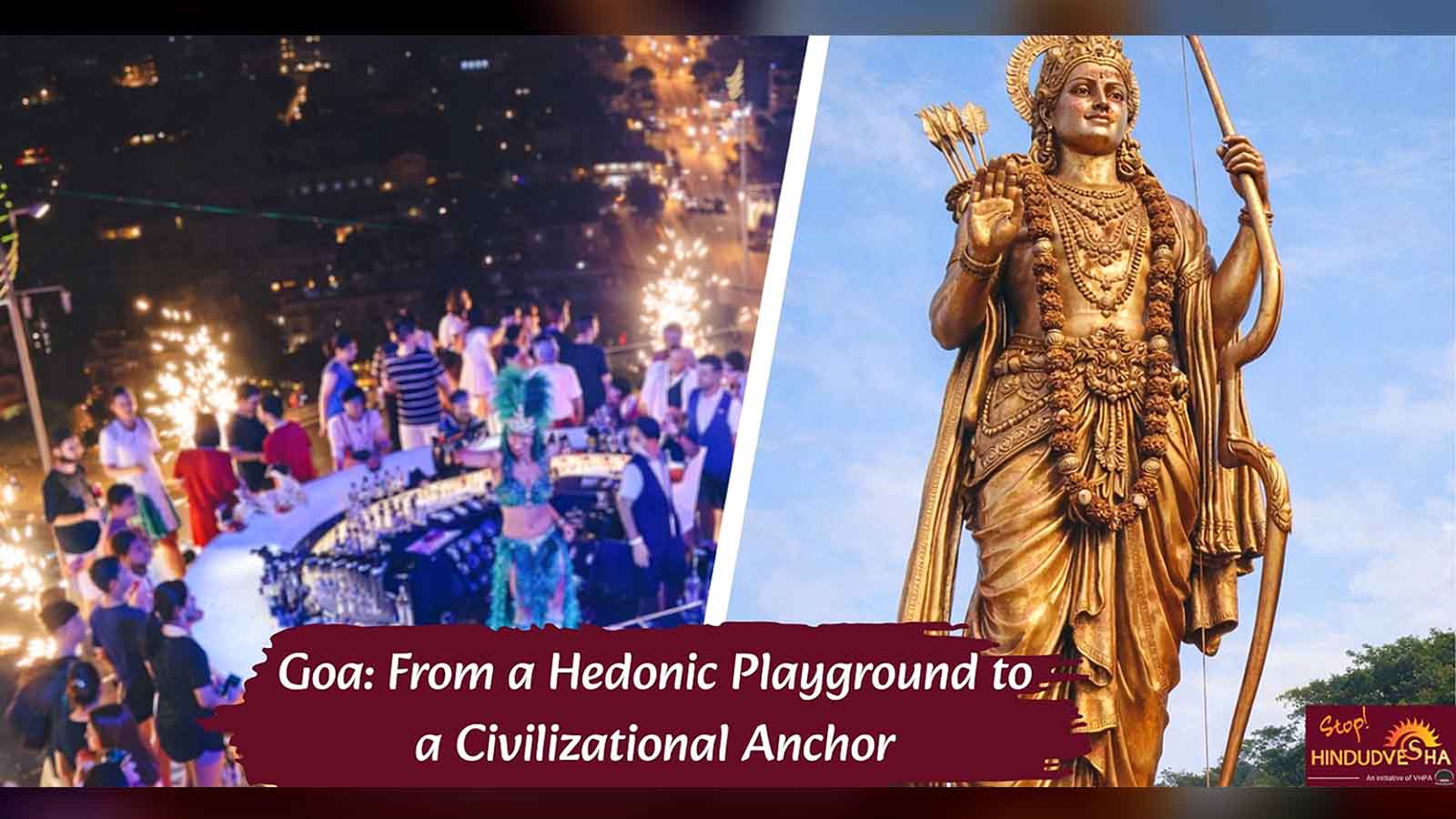
Behind Goa’s tourist image lies a suppressed Hindu civilization now reclaiming space through temple restoration, revived festivals, and historical reckoning with colonial violence, forced conversions, and the enduring legacy of the Goan Inquisition.
- The land of churches and beaches is at the threshold of a civilizational makeover, with the drug and party culture losing its allure and the hitherto concealed Hindu heritage of Goa making its presence felt.
- The unveiling of Bhagwan Ram’s statue in Goa in November 2025 carries deep symbolic significance amid the near-erasure of the state’s Hindu heritage. The brutality of Portuguese rule, compounded by post-independence civilizational apathy, led to the systematic destruction of Goa’s Sanatani roots.
- For the past couple of years, the Goa government has been promoting temple tourism in the state and restoring and reconstructing Hindu temples destroyed during the Portuguese invasion.
- Even though Goa is slowly but decisively embracing its Hindu roots, the conspicuous absence of the Goa Inquisition – a pinnacle of Hindu persecution – from mainstream public discourse exemplifies the complexity of this endeavour.
When a society continues to define itself through the cultural residue of its former colonizers decades after political rule has ended, it signals not continuity but decay. Over time, this decay hardens into civilizational amnesia, where an imposed identity is internalized and presented as authentic inheritance. In its most troubling form, this becomes a cultural Stockholm syndrome.
Goa is a textbook case.
To the world, Goa is sold as India’s playground: beaches, rave parties, drugs, alcohol, and a carefully cultivated Western aesthetic. It is framed as a hyper-liberal exception within India, proudly detached from its civilizational roots. What this narrative erases is that Goa’s history did not begin with Portuguese conquest. It possessed a rich Hindu civilizational life long before colonial rule, one that was systematically dismantled rather than organically replaced.
The Portuguese period, now romanticized through churches and architectural nostalgia, was marked by coercion and brutality. The Goan Inquisition imposed draconian laws, criminalized indigenous religious practices, and subjected Hindus to sustained persecution[1]. This was not cultural exchange but cultural destruction. Yet for decades, Goa’s global appeal rested on a sanitized colonial memory, where violence was repackaged as heritage and erasure as charm.
That narrative is finally weakening.
Over the past decade, Goa has begun shedding its colonial after-image. For perhaps the first time since Liberation, there is public recognition of the state’s suppressed Hindu identity. Government initiatives to promote temple tourism and develop pilgrimage circuits reflect a deeper shift in self-perception. The party-and-drug monoculture that once defined Goa’s image is losing its exclusivity. In its place, an older and more rooted Goa is resurfacing.
This change is not merely regional. It mirrors a broader civilizational reawakening across Bharat, where suppressed histories are being reclaimed and cultural confidence is returning. Goa’s transformation is not a rejection of openness or modernity. It is a correction—one that restores memory, dignity, and continuity to a land long compelled to forget itself.
Spotlight on Goa’s Hindu Heritage
When the Indian Prime Minister Modi unveiled a 77-foot-tall bronze statue of Bhagwan Ram at South Goa’s Shree Samsthan Gokarn Jeevottam Matha in November 2025, it created cognitive dissonance for those accustomed to seeing Goa primarily as a nightlife and beach-hopping destination. One of the tallest statues of Bhagwan Ram in the world, the Goa statue was designed by sculptor Ram Sutar, best known for creating the Statue of Unity in Gujarat.
Among the country’s oldest monastic institutions, the Matha holds a special place within the Gaud Saraswat Brahmin community and has long served as an important Vaishnava spiritual seat. The Matha’s premises were established nearly 370 years ago, giving it deep historical and religious significance. The unveiling of the Bhagwan Ram statue coincided with the 550th anniversary of the Matha tradition[2] [3] [4].
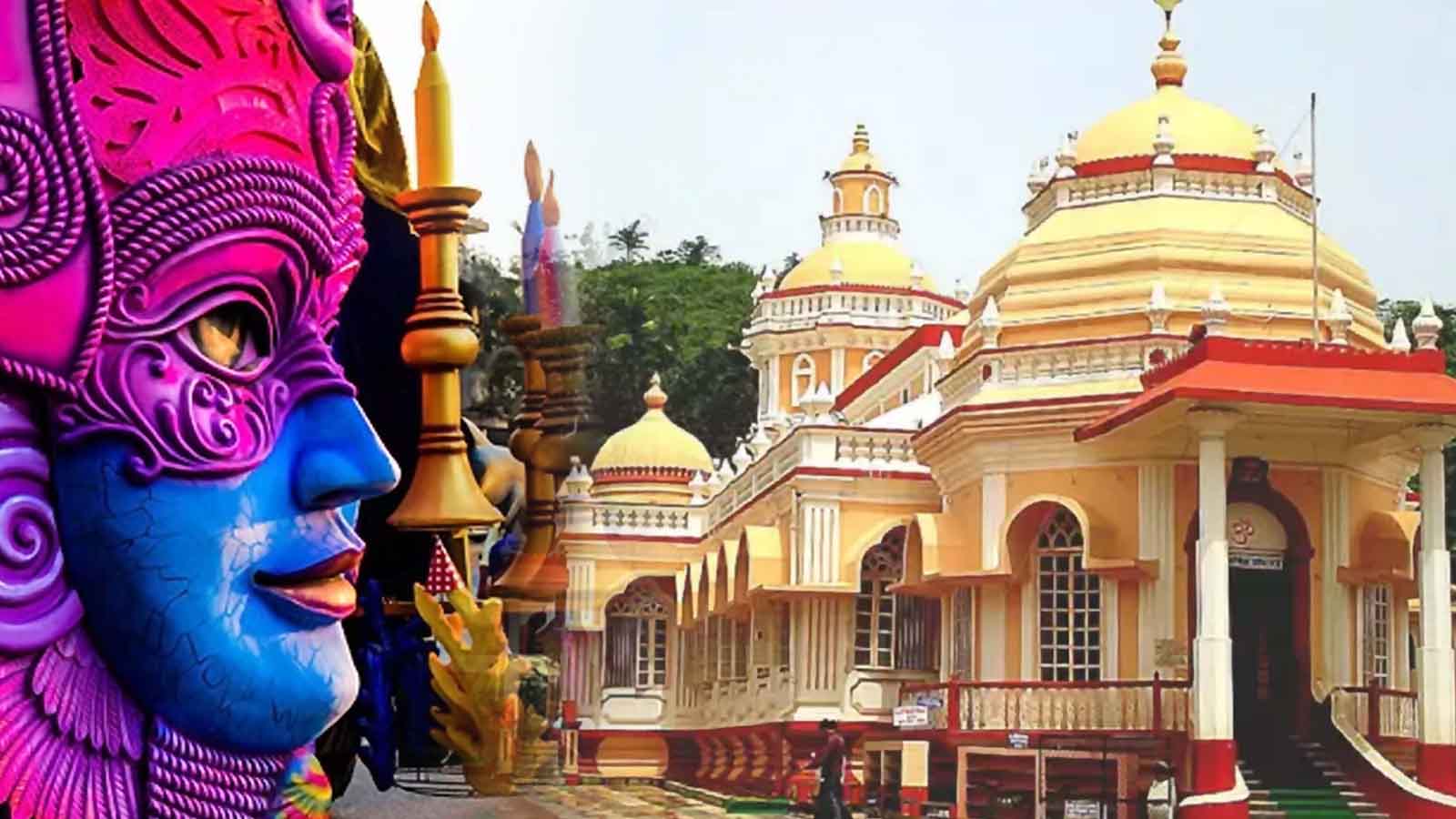
Along with the unveiling of the statue, Prime Minister Modi also inaugurated a Ramayana Theme Park Garden developed on the Matha premises. He further released a special commemorative postal stamp and coin to mark the occasion.[5]
The unveiling of Bhagwan Ram’s statue in Goa carries deep symbolic significance amid the near erasure of the state’s Hindu heritage. The violence of the Portuguese invasion, compounded by the civilizational indifference of post-independence governments toward Goa’s Hindu past, resulted in the systematic destruction and marginalization of its Sanatani roots.
The Christianization of Goa under Portuguese rule stands as one of the darkest chapters in India’s history. It was marked by the large-scale destruction of temples, the use of violence to enforce conversions, and the imposition of draconian bans on the public practice of Hindu rituals and traditions[6]. The Goan Inquisition, initiated in the 16th century, led to the torture and killing of thousands of Indians on charges such as blasphemy against Christianity, idolatry, witchcraft, and necromancy. This machinery of persecution continued well into the 17th and 18th centuries[7].
Against a landscape dominated by churches, cathedrals, and other symbols of Portuguese oppression—now routinely marketed as Goa’s “cultural legacy”—the state’s Hindu origins remained largely concealed. However, India’s ongoing civilizational and cultural resurgence has begun to shift this narrative, bringing Goa’s Vedic roots back into focus.
Stories long excluded from the mainstream account of Goa are now being revisited. Among them is the story of Bhagwan Parshuram, a revered figure in Bharat’s Dharmic tradition. Often referred to as the “Father of Goa,” Parshuram is believed to have played a central role in the creation of the Konkan region, which includes present-day Goa. According to tradition, he created the Sahyadri range and then shot an arrow into the western seas, causing the waters to recede and reveal the land that became Goa.[8] [9]
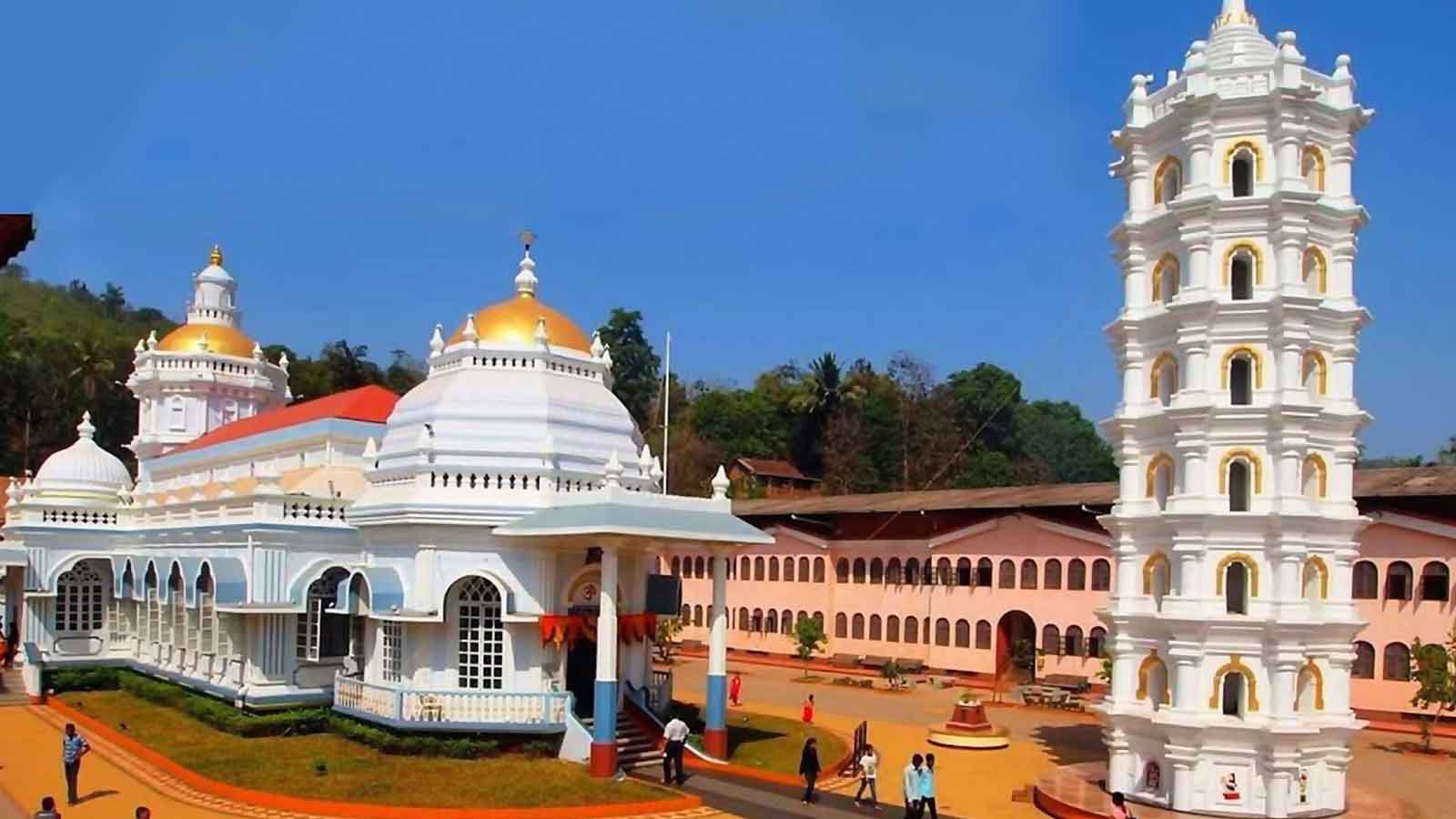
Ancient texts refer to Goa by several names, including Gopakapattana, Gomanchala, Gopakapuri, Gopakapattam, Govem, Govapuri, and Gomantak. According to Dharmic tradition, after creating the landmass, Bhagwan Parshuram invited Brahmin communities to settle in the region and perform Vedic rituals. Over time, these Brahmins came to be known as the Saraswat Brahmins, who went on to contribute significantly to Goa’s cultural and civilizational fabric [10].
In June 2023, Goa Chief Minister Pramod Sawant unveiled the ‘Gomantbhumi Janak Parshuram’ statue in Panaji, formally recognizing and honoring the central place of Bhagwan Parshuram in Goa’s civilizational history[11].
Bhagwan Parshuram also has several temples dedicated to him in Goa, including the Parshuram Temple in Painguinim. Representing the ideals of justice, discipline, and unwavering commitment to Dharma or righteousness, his association with the land of Goa forms an integral part of its Dharmic history and cultural identity[12].
Another important expression of Goa’s Hindu heritage is Shigmotsav, a vibrant spring festival widely known for its colorful processions and folk traditions. Rooted in the state’s Hindu past, Shigmotsav reflects Goa’s ancient agrarian and cultural rhythms. In recent years, the festival has witnessed a revival, aided by sustained government efforts to promote cultural heritage beyond the narrow frame of beach tourism.
The 2025 celebrations, held from March 15 to March 29, wove an evocative tapestry of dance, music, temple rituals, and a wide range of street performances, offering a glimpse into Goa’s traditional roots. Primarily an agrarian festival, Shigmotsav marks the end of the farming season, allowing communities to honor local deities and celebrate through traditional folk music, dance, and collective festivity[13].
The festival also features depictions of scenes from the Mahabharata and Ramayana through an eclectic blend of folk dances, intricately designed floats, and traditional street-style performances. Shigmotsav is celebrated in two distinct forms. Dhakto Shigmo, typically observed in Goan villages, focuses on preserving the festival’s Hindu roots. Traditional temple rituals are presented in their original form, and folk performances adhere closely to their authentic styles and rhythms. This version is known for its intimate, community-centered character, with a strong emphasis on the distinctiveness of temple traditions.
Vhadlo Shigmo, by contrast, is the grander version of the festival, celebrated in cities such as Mapusa, Panaji, Margao, and Vasco. Here, the emphasis shifts toward scale and spectacle, with elaborate processions, vibrant floats, and a carnival-like atmosphere designed to engage larger audiences while retaining the festival’s cultural essence[14].
Temple Tourism Gets a Boost
While temple tourism is witnessing an unprecedented surge across India, Goa’s public image continues to be shaped by familiar stereotypes of historic churches, beach shacks, and nightlife. The idea of tourists visiting Goa to perform pooja at a temple still appears incongruous with the hyper-Westernized image that has long dominated the mainstream narrative.
That image, however, has begun to shift over the past few years. Goa is in the midst of a quiet rebranding, with increasing attention being directed toward its Dharmic heritage. The state government has stepped up efforts to promote temple tourism, signaling a broader attempt to rebalance how Goa is seen, both within India and abroad.
In June 2023, the Goa government signed a Memorandum of Understanding with Temple Connect, an organization focused on the development and revival of the temple ecosystem. According to State Tourism Minister Rohan Khaunte, the partnership aims to enhance Goa’s tourism potential by integrating its temples into a Global Circuit. Under this collaboration, temples in urgent need of preservation and restoration will be jointly identified, and targeted initiatives will be undertaken to ensure their long-term maintenance, development, and accessibility[15].
Under the MoU, the government is focusing on improving infrastructure around temples, including accessibility, visitor amenities, signage, and parking facilities. The agreement also outlines a roadmap for conducting specialized training programmes and workshops for temple priests and other stakeholders within the temple ecosystem. These initiatives will focus on communication skills, heritage conservation, and hospitality, with the aim of strengthening and professionalizing temple tourism[16].
In June 2025, Goa Tourism launched the “Ekadasha Teertha Yatra,” a pilgrimage circuit comprising 11 iconic temples that reflect the state’s rich Dharmic and civilizational legacy. As part of the Yatra, tourists are expected to visit approximately 4 temples per day, allowing the entire circuit to be completed in 2 to 3 days. The circuit includes several historically significant temples, such as the Shri Mahalasa Narayani Temple in Mardol, North Goa; the Sri Manguesh Temple in Mangeshi, North Goa; the Sri Shantadurga Temple in Fatorpa, South Goa; and the Mahadev Temple at Tambdi Surla, South Goa[17] [18].
In an interview with Gomantak Times Digital, Director of the Goa Tourism Department, Kedar Naik, emphasized that the temple tourism initiative will neither interfere with the Dharmic essence of the temples nor dilute the sanctity of their rituals and traditions. He noted that visitors would be educated about local customs, appropriate conduct, and attire through trained guides, informational signage, and curated materials.
Naik also highlighted that the initiative aims to promote both domestic and international tourism through participation in spiritual tourism expos, increased visibility on spiritual travel platforms, and content partnerships with travel influencers. As part of these efforts, a group of influencers from Uzbekistan recently visited the Shri Mangesh Temple in Mangueshi, Ponda.
The Ekadasha Teertha Yatra will also include a range of initiatives to showcase Goa’s folk arts and local culture. These include heritage storytelling sessions as well as dedicated spaces for local artisans to display and promote traditional crafts, ensuring that cultural engagement extends beyond temple visits alone[19].
Positioning Goa as a temple tourism destination marks a significant step toward redefining its civilizational narrative. For decades, the state has been primarily associated with churches that commemorate some of the most brutal figures of missionary history, including St. Francis Xavier, whose role in enforcing conversions through torture and violence was central to the establishment of the Goan Inquisition[20]. Yet these churches continue to be celebrated across Goa as part of its “historical legacy,” with the missionary enterprise routinely glorified while the large-scale violence inflicted on the indigenous Hindu population is glossed over or ignored[21].
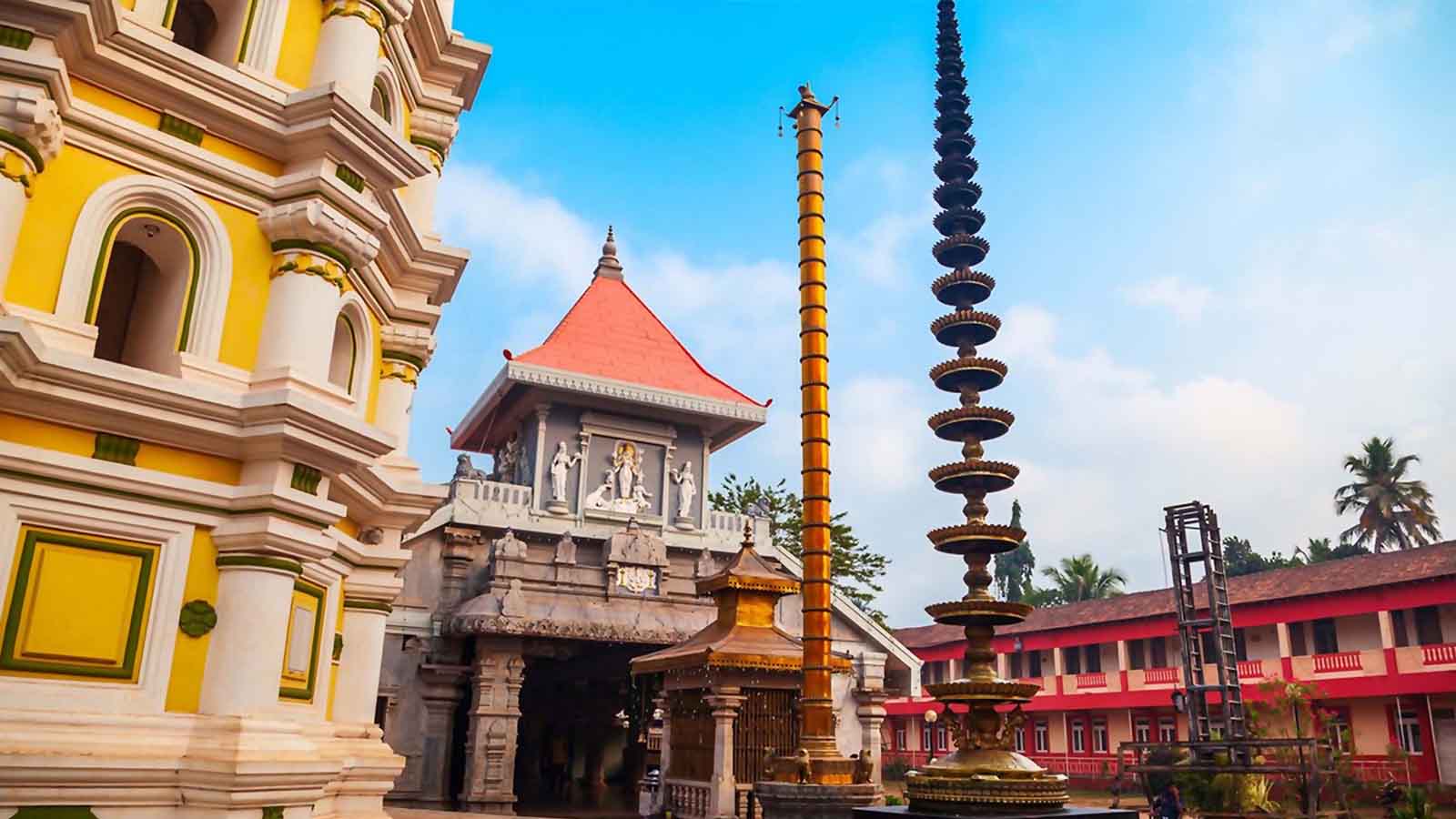
Against this backdrop, the push to promote Dharmic and temple tourism signals the emergence of a new narrative. This shift may not directly confront or dismantle the entrenched glorification of the Portuguese legacy, but it performs a quieter and arguably more consequential task: it restores visibility to Goa’s Hindu past. By foregrounding temples, pilgrimages, and living traditions, the state is beginning to re-anchor its identity in a civilizational history that long predates colonial intrusion and has endured despite systematic erasure.
In May 2025, the Chief Minister of Goa, Pramod Sawant, described the land as a “yog bhumi” rather than a “bhog bhumi.” Addressing a gathering of over 14,000 people at the Sanatan Rashtra Shankhnad Mahotsav, he said that Goa is not merely a land of sand, sun, and beaches, but also home to some of the most beautiful and clean temples. He further spoke about the involvement of local communities in sustaining the state’s temple infrastructure, emphasizing that local committees and villages are responsible for managing temples, and that every village traditionally worships its own local deities[22].
Destruction of Goa’s Hindu Heritage – A Conveniently Concealed Truth
Despite India’s broader civilizational and cultural resurgence, the erasure of Goa’s Hindu heritage has received relatively little attention. When discussions turn to the revival of ancient Dharmic sites, Goa rarely features in the public imagination. This is largely because the state’s culture has long been presented almost exclusively through the colonial Portuguese lens, leaving scant space in mainstream media and public discourse for engagement with Goa’s suppressed Hindu past.
Yet Goa’s Hindu heritage extends far deeper than commonly acknowledged, reaching back to prehistoric times. Archaeological discoveries have established Acheulean occupation from the Lower Paleolithic era in the Western Ghats, underscoring the antiquity of human presence in the region. Evidence from the Paleolithic period has been found across several parts of Goa, including rock art engravings on laterite platforms and granite boulders, as well as stone tools such as axes, choppers, and petroglyphs dating back nearly 10,000 years[23].
Goa has also been home to several prominent Hindu rulers, as evidenced by historical records and archaeological findings. Written accounts date back to the 3rd century BCE, when Goa formed part of Chandragupta Maurya’s expansive empire. In subsequent periods, the region came under the rule of the Satavahana dynasty, followed by the Bhojas, Chalukyas, Shilaharas, and the Kadambas. Under Kadamba rule, Goa emerged as an important center of trade and commerce, and both Hindu Dharma and Jainism flourished during this period. [24]
The period of Kadamba rule, spanning roughly from 1000 to 1400 CE, saw a revival of local Hindu culture, with numerous temples constructed across the Goan heartland. Among the Puranas, the Skandapurana offers one of the most detailed narratives of Goa’s Hindu past, particularly recounting the migration of Saraswat Brahmins from North-East India to the region. The text also names several deities worshipped by the Gauda Saraswat Brahmins who became integral to Goa’s religious landscape, including Śantadurgā, Mahālaksmī, Mangeśa, Saptakotīśvara, and Nageśa. These deities are still venerated in temples across Goa to this day[25].
During Portuguese rule, Goa’s Hindu heritage was systematically devastated. The large-scale destruction of Hindu temples, images, and shrines was accompanied by their deliberate replacement with Christian monuments and iconography[26]. Owing to the absence of comprehensive records and the scarcity of surviving reference material, it is difficult to determine the exact number of temples that were destroyed or replaced by churches. Nevertheless, when fragments of evidence from various sources are pieced together, a clearer and more plausible picture of this widespread erasure begins to emerge:
“A deep well in the St. Cajetan Church (completed in 1661 and now a UNESCO World Heritage Site), points to the existence of Hindu temples in Old Goa. It is believed that Archbishop Aleixio de Menezes constructed the Holy Trinity Church on the ruins of a Shiva temple. In its neighbourhood exists a pushkar to fulfil the water requirements of the now-missing temple. According to a copper plate inscription belonging to Tribhuvanamalla of 1107 CE, there was a Brahmapuri colony for Brahmins on the outskirts of present-day Old Goa, where Shiva was worshipped as Goveshwar. The Brahmin families lived near a temple of Devi Sarasvati”. (From a write-up published by the Centre for Indic Studies, Indus University, Ahmedabad). [27]
Restoration of Temples Destroyed During the Portuguese Invasion
In March 2022, the Goa government allocated ₹200 million in its budget for the restoration and reconstruction of temples and other Dharmic sites destroyed during the Portuguese invasion[28]. This first-of-its-kind initiative carries strong symbolic significance against the backdrop of decades of whitewashing the violence and brutality of Portuguese rule in Goa. It marks a clear shift in narrative, with the state government formally acknowledging the historical trauma associated with the so-called Portuguese legacy and taking a step toward correcting a long-standing colonial distortion.
An Expert Committee was constituted in 2023 to examine representations seeking the reconstruction or restoration of temples destroyed during Portuguese rule. The committee’s report, which is available online, assesses more than 20 Dharmic sites submitted for consideration. These assessments are based on the presence of structural remnants, relics, and architectural features indicating the possible existence of temples at these locations. Following a detailed evaluation, the committee issued site-specific recommendations, either proposing that a site be notified as protected by the Goa government’s Department of Archaeology or that its archaeological potential be further explored by the department[29].
The report states that more than 1,000 Hindu temples were destroyed during the Portuguese invasion and the Goa Inquisition. It also puts forward the following recommendations:
- The construction of a Smarak-Devalaya, or temple memorial, to re-establish deities whose original sites were usurped under colonial rule.
- The establishment of a temple museum dedicated to showcasing Goa’s ancient temple heritage.
- The translation of select Portuguese records into English to facilitate deeper research into the destruction of temples during Portuguese rule in Goa.
The formulation of schemes to support major and minor research projects, encouraging scholars and researchers to study and document Goa’s temple heritage[30].
Wrapping Up
The ongoing resurgence of Goa’s Hindu heritage has invited a predictable narrative backlash from a familiar ecosystem[31] [32] [33]. Stock accusations of alleged right-wing appropriation of Goa’s culture and claims of “Hindutva” politics encroaching upon the state’s supposed “Portuguese legacy” have once again surfaced.
More broadly, Bharat’s civilizational and cultural resurgence has consistently been framed through a similar discursive lens by the left-liberal establishment. Goa, however, presents a more layered challenge. Even as efforts are underway to reclaim its Dharmic heritage, the colonial narrative of an overriding “Portuguese legacy” continues to dominate mainstream discourse. The near-complete absence of serious engagement with the Goa Inquisition—one of the most severe episodes of Hindu persecution—from public discussion underscores this imbalance and highlights the unresolved tension at the heart of Goa’s civilizational reckoning.
Source: https://stophindudvesha.org/goas-hindu-revival-reclaiming-a-civilization-buried-under-centuries-of-colonial-rule/
Citations
[1] Francis Xavier – the homicidal maniac who pioneered pogroms against Hindus; StopHinduDvesha. https://stophindudvesha.org/francis-xavier-the-homicidal-maniac-who-pioneered-pogroms-against-hindus/
[2] 77-Foot Lord Ram Statue, Tallest In The World, Unveiled By PM Modi In Goa; https://www.ndtv.com/india-news/pm-modi-unveils-77-foot-lord-ram-statue-in-goa-tallest-in-the-world-9715687
[3] Lord Ram statue, Goa: Why Lord Ram’s tallest statue has come up in party-paradise Goa – India Today; https://www.indiatoday.in/india/story/goa-party-paradise-worlds-tallest-lord-ram-statue-why-history-partagali-math-unveiling-pm-modi-explained-2828059-2025-11-30
[4] At 77 feet, PM Modi unveils world’s tallest statue of Lord Ram in Goa; https://www.newindianexpress.com/nation/2025/Nov/28/at-77-feet-pm-modi-unveils-worlds-tallest-statue-of-lord-ram-in-goa
[5] PM inaugurates Ramayana Theme Park in Goa; participates in 550th | DD News; https://ddnews.gov.in/en/pm-inaugurates-ramayana-theme-park-in-goa-participates-in-550th-year-celebrations-of-math/
[6] Conversions And Citizenry: Goa under Portugal 1510-1610 by Delio de Mendonca; https://www.google.co.in/books/edition/Conversions_and_Citizenry/Mh3kKf0VSfQC?hl=en&gbpv=1
[7] Goa Inquisition – The Epitome of Christian Missionary Violence; https://www.goainquisition.info/2020/05/the-portuguese-and-goan-inquisition.html
[8] Legacy of Lord Parshuram in Goa and Goa’s Hindu Heritage; https://advocatetanmoy.com/legacy-of-lord-parshuram-in-goa-and-goas-hindu-heritage/#google_vignette
[9] Culture & Heritage | North Goa District, Government of Goa | India; https://northgoa.gov.in/culture-heritage/
[10] Legacy of Lord Parshuram in Goa and Goa’s Hindu Heritage; https://advocatetanmoy.com/legacy-of-lord-parshuram-in-goa-and-goas-hindu-heritage/#google_vignette
[11] CM unveiled the Gomantbhumi Janak Parashuram statue – Goa News Hub; https://goanewshub.com/cm-unveiled-the-gomantbhumi-janak-parashuram-statue/
[12] Legacy of Lord Parshuram in Goa and Goa’s Hindu Heritage; https://advocatetanmoy.com/legacy-of-lord-parshuram-in-goa-and-goas-hindu-heritage/#google_vignette
[13] Shimgotsav: Goa’s grand cultural extravaganza beyond beaches and parties; https://organiser.org/2025/03/24/284119/bharat/shigmotsav-goas-grand-cultural-extravaganza-beyond-beaches-and-parties/
[14] Ibid.
[15] Goa Government Set To Revive Temple Heritage Of Goa; https://www.outlooktraveller.com/News/goa-government-set-to-revive-temple-heritage-of-goa
[16] Ibid.
[17] Goa launches ‘Ekadasha Teertha Yatra’ To Promote Temple Tourism; https://news.abplive.com/cities/goa-launches-ekadasha-teertha-yatra-to-promote-temple-tourism-1780606
[18] Beyond beaches: Goa to promote temple visits under spiritual tourism drive | India News – Business Standard; https://www.business-standard.com/india-news/beyond-beaches-goa-to-promote-temple-visits-under-spiritual-tourism-drive-125061700277_1.html
[19] Goa’s temple tourism to honour tradition: Kedar Naik | Gomantak Times; https://www.gomantaktimes.com/my-goa/art-culture/goas-temple-tourism-to-honour-tradition-kedar-naik
[20] Goa Inquisition – The Epitome of Christian Missionary Violence; https://www.goainquisition.info/2020/05/the-portuguese-and-goan-inquisition.html
[21] Goan Churches | Information on all Churches in Goa; https://goanchurches.info/saint/st-francis-xavier/
[22] Not just for sun & sea, people now come to Goa for temples, culture: CM | Goa News – The Times of India; https://timesofindia.indiatimes.com/city/goa/not-just-for-sun-sea-people-now-come-to-goa-for-temples-culture-cm/articleshow/121241438.cms
[23] Goa’s glorious Hindu history and brutal Inquisition: A long forgotten and rarely discussed saga – Firstpost; https://www.firstpost.com/opinion-news-expert-views-news-analysis-firstpost-viewpoint/goas-glorious-hindu-history-and-brutal-inquisition-a-long-forgotten-and-rarely-discussed-saga-11276681.html
[24] Ibid.
[25] Ibid.
[26] Destruction of Hindu temples in Goa by Christian fanatics | #ReclaimTemples; https://reclaimtemples.com/destruction-of-hindu-temples-in-goa-by-christian-fanatics/
[27] Centre for Indic Studies; https://cisindus.org/indic-varta-internal.php?vartaid=415
[28] ‘Rs 20cr to rebuild temples destroyed by Portuguese’ | Goa News – Times of India; https://timesofindia.indiatimes.com/city/goa/rs-20cr-to-rebuild-temples-destroyed-by-portuguese/articleshow/90552253.cms
[29] Report of the Committee of Experts 2023; https://static.goavidhansabha.gov.in/goalpub/docs/question_docs/file_cb551d26-5029-414b-9c9a-13620d01167c.pdf
[30] Ibid.
[31] Goa Govt Plans Memorial for Portuguese-Era Destroyed Temples, Critics See Vote-Bank Politics – UCA News; https://www.ucanews.com/news/indias-goa-state-plans-memorial-for-portuguese-destroyed-temples/110285
[32] The undoing of India’s former Portuguese colony nears completion – UCA News; https://www.ucanews.com/news/the-undoing-of-indias-former-portuguese-colony/110537
[33] Goa: BJP buries Parrikar model, whips up hardline Hindutva; https://www.deccanherald.com/opinion/goa-bjp-buries-parrikar-model-whips-up-hardline-hindutva-1106641.html

![[ India Today ] Ohio senator JD Vance thanks wife, a Hindu, for helping him find Christian faith](https://hinduvishwa.org/wp-content/uploads/2024/06/us-senator-jd-vance-reveals-how-his-hindu-wife-usha-helped-him-find-his-christian-faith-image-re-272530504-16x9_0-120x86.webp)